Plants That Will Naturally Clear Your Pond Water
Apr 19th 2024

Apr 19th 2024
Duck Potato, American Pondweed, and Pickerel Weed are the three pond plants most often used to keep pond water clear, because they pull the dissolved nitrogen and phosphorus out of the water that would otherwise feed algae. These plants prevent new cloudiness rather than clearing water that has already turned muddy or green.
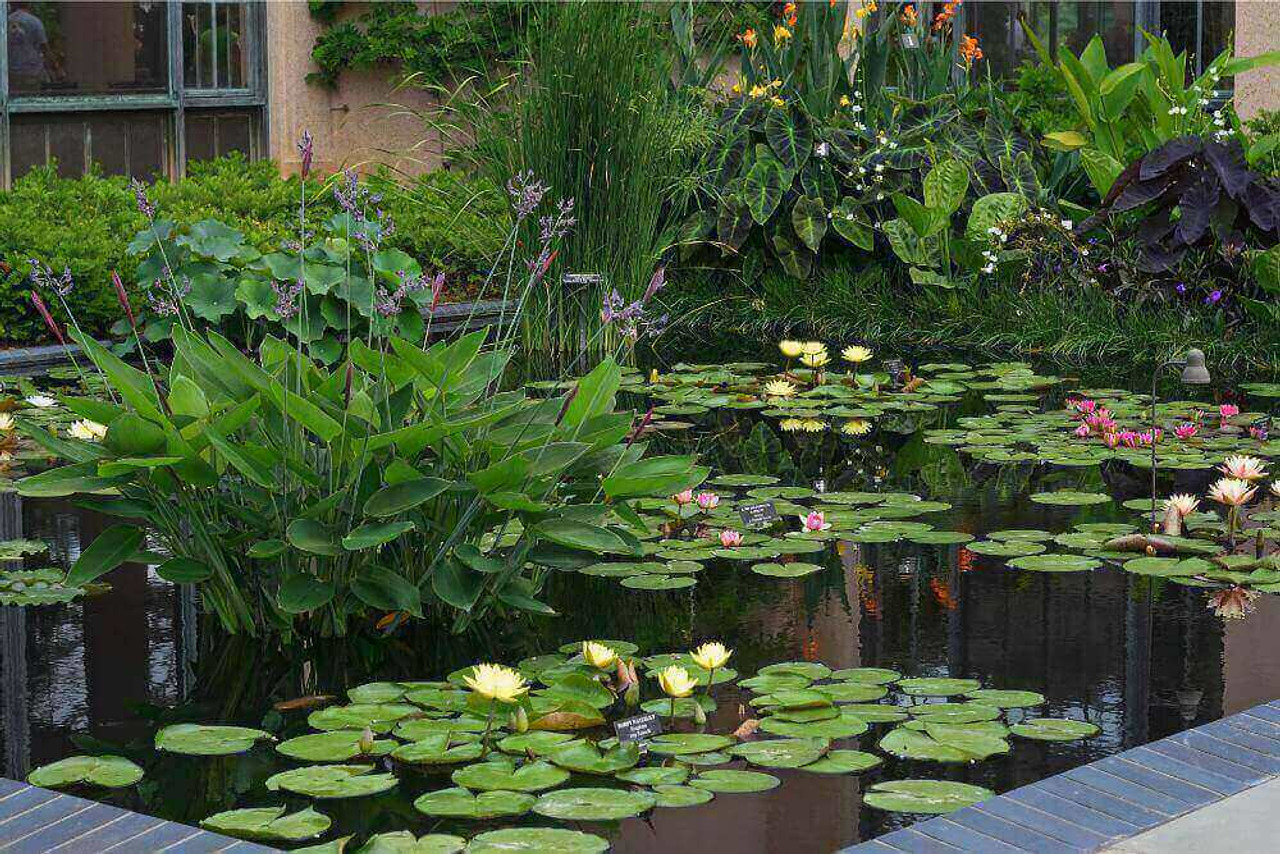
Pond water turns cloudy when dissolved nutrients build up faster than the pond can process them. Three aquatic plants help hold that balance in place: Duck Potato, American Pondweed, and Pickerel Weed. Each one draws nitrogen and phosphorus out of the water, competes with algae for the same nutrients, and adds the shade and cover that pond fish use through the warm months. Below is what each plant does, how to care for it, and where plants fit alongside mechanical pond filtration.
Pond plants do not filter water the way a pump and media do. They compete with algae for food. Algae blooms need dissolved nitrogen and phosphorus, and those nutrients come from fish waste, uneaten food, decaying leaves, and runoff. A well planted pond puts rooted and submerged plants in the path of those nutrients, so the plants absorb them into leaf and root growth before algae can use them.
That is why plant coverage matters more than plant count. Aim to have plants and floating leaf cover across a meaningful share of the surface, keep the planted shelves in sun, and thin the growth back each season so the nutrients leave the pond with the trimmings instead of decaying back into the water.
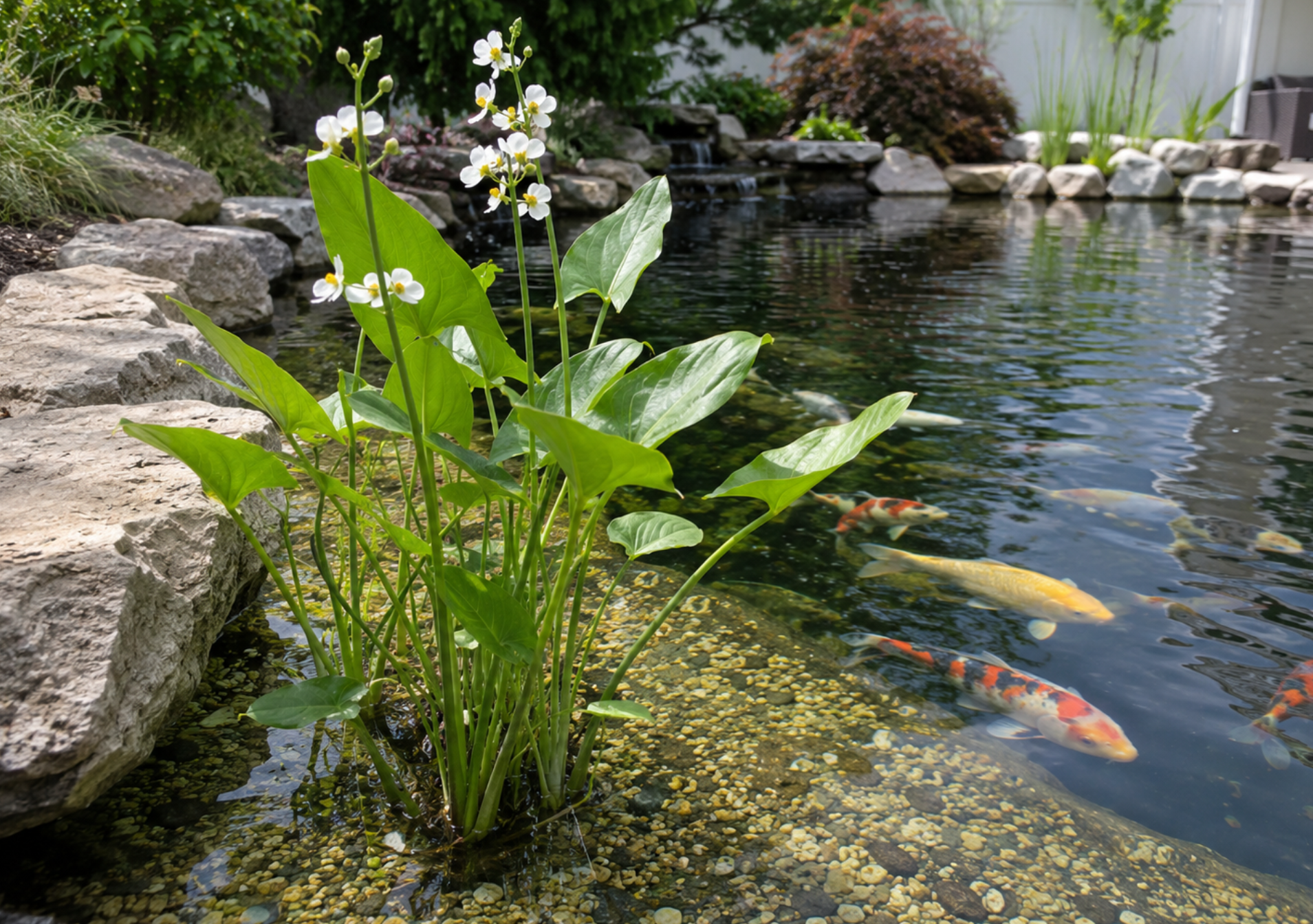
This perennial plant is emergent and can thrive in water with depths between six and twelve inches. It can reach heights up to four feet, and contains leaves which are wide with white colored flowers that have three petals. In addition to keeping pond water clear, it also provides outstanding cover and can serve as a source of food for various pond animals.
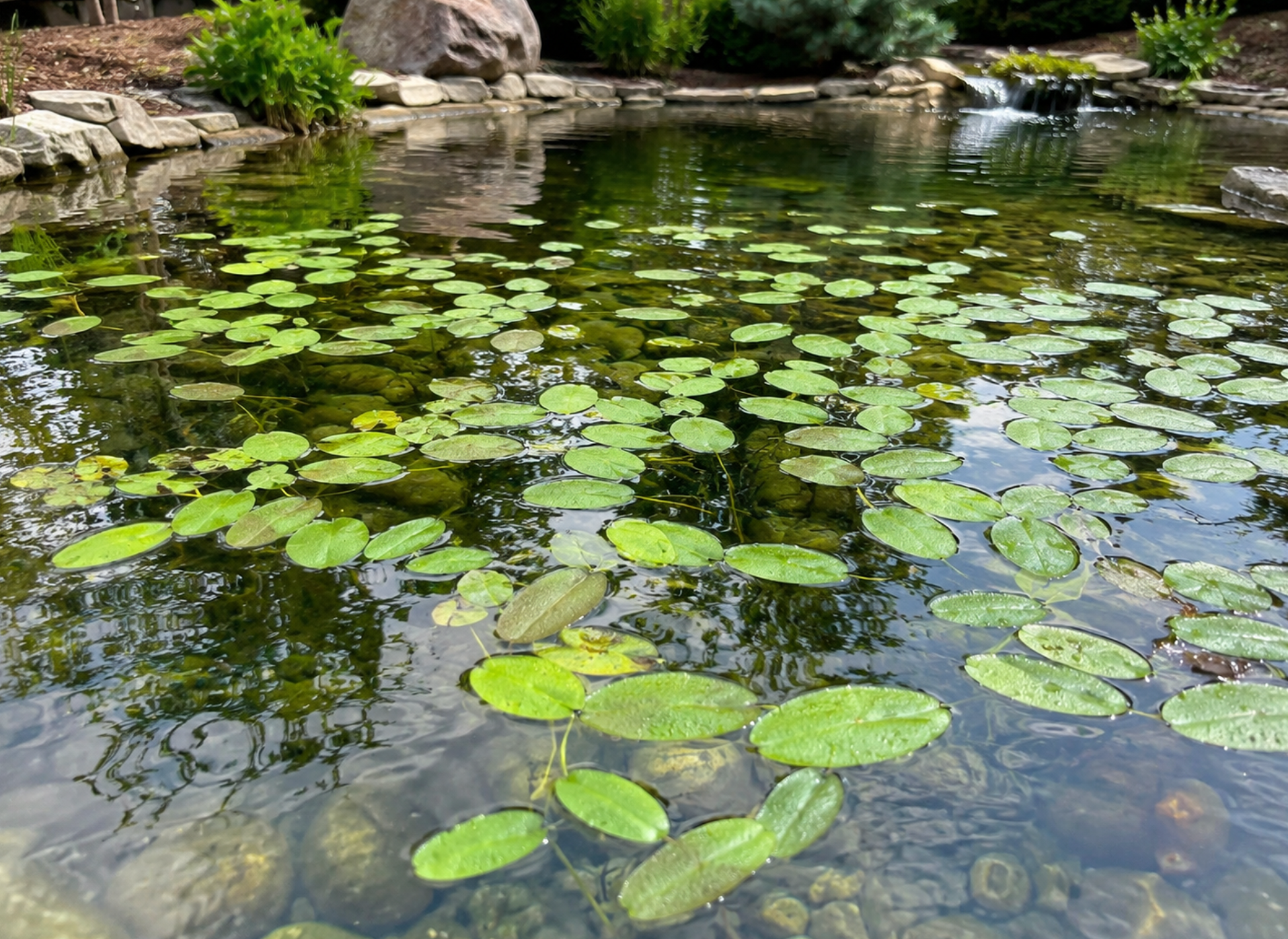
American Pondweed is a perennial with leaves that both submerge and float, and it grows natively across most of the United States, including New Jersey, New York, and Pennsylvania. It produces fruit that matures from late spring into early summer. It creates an outstanding fish habitat, while serving as a food source for various forms of wildlife, especially ducks.
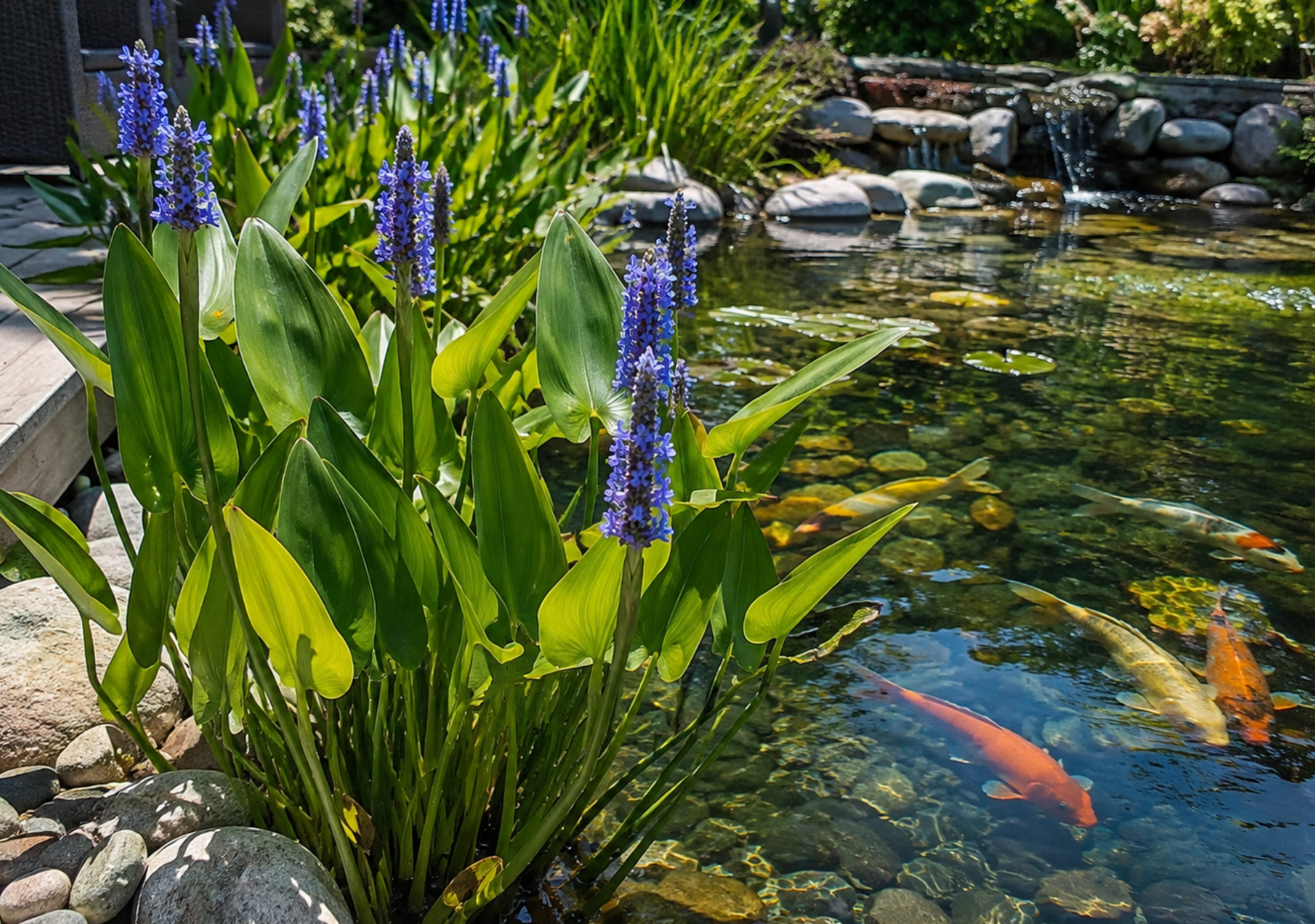
Pickerel Weed is a perennial native to New Jersey and the wider eastern United States, and it is arguably the most visually striking of the three. This is because of its luminous green leaves and stems which produce a bloom of flowers which have vibrant violet/blue coloration. It reaches two to four feet tall in three to twelve inches of water, and pond fish feed on the macroinvertebrates that live on its stems.
Duck Potato (Sagittaria latifolia)
Depth: 6 to 12 inches. Height: up to 4 feet. Placement: shallow shelves and pond margins. Also provides cover and a food source for pond wildlife.
American Pondweed (Potamogeton nodosus)
Depth: rooted in deeper water, leaves submerge and float. Placement: open water off the shelf. Also provides fish habitat. Spreads readily, so plan to thin it.
Pickerel Weed (Pontederia cordata)
Depth: 3 to 12 inches. Height: 2 to 4 feet. Placement: pond edges and bog filter areas. Also provides violet-blue summer bloom and cover for invertebrates.
All three are shallow water plants, so use a shelf or a bog area.
Maintaining the clarity of your pond water can be a real challenge, especially as it ages. The key thing to remember about these three plants is that while they are good at preventing pond water from becoming dirty, they are not so good at clearing up water that is already dirty. In other words, if you’ve allowed your pond water to become muddy you’ll need to rectify this issue first before you can install these plants and benefit from them.
Actually, if you add Duck Potato, American Pondweed or Pickerel Weed to the pond water without cleaning it first, you actually run the risk of killing these plants. The reason for this is because of inadequate sunlight. The sun’s rays won’t be able to thoroughly penetrate pond water which is muddy and cloudy, and since all plants rely on photosynthesis to thrive, your plants will quickly succumb.
That being said, it is important to run a mechanical filter to clear the pond water, and afterwards you can install the three plants. If you are not sure whether your pond is ready for new vegetation, a pond professional can test the water and check the filtration before you plant, which is part of the professional pond maintenance our team provides across New Jersey, New York, and Pennsylvania. Another essential tip for maintaining pond water clarity is the installation of a filter near the shorelines, which will either stop or substantially slow down the runoff which results from rain. These three plants are not only prized for their ability to keep water clear, but also due to the fact that they provide food that your fish will eat, as certain invertebrates are attracted to these aquatic species.
Duck Potato, American Pondweed, and Pickerel Weed are all native to the Northeast, which is why they hold up through a New Jersey winter and return the following spring. The right mix still depends on your pond: how deep it is, how wide the planting shelves are, how much direct sun the surface gets, and how heavily the pond is stocked with koi.
Fitz's Fish Ponds designs, builds, and maintains ponds and water features across New Jersey, New York, and Pennsylvania, and our live pond plants are available online and through our retail locations in Colts Neck, Green Brook, and Fairfield, New Jersey, and New Hope, Pennsylvania. If your water is cloudy right now, start with filtration and water quality, then plant. Call (908) 420-9908 or stop into a store and we will talk through what will work in your pond.
Duck Potato, American Pondweed, and Pickerel Weed are the three most commonly used. Each absorbs dissolved nitrogen and phosphorus, the same nutrients algae need to bloom. Water lilies, hornwort, and other submerged and floating plants work the same way. The effect comes from total plant coverage rather than from any single species.
No. Plants reduce the nutrients that cause green water, but they do not move water, trap solids, or handle the ammonia load from a stocked koi pond. Plan on plants working alongside mechanical and biological filtration, not instead of it.
Not reliably. These three plants prevent new cloudiness rather than reversing it, and muddy water blocks the sunlight the plants need to establish. Clear the water first with filtration and a water quality check, then plant.
There is no single number that fits every pond. As a working target, cover a meaningful share of the surface with plant and floating leaf growth, concentrate rooted plants on sunlit shelves, and increase coverage as fish load increases. A pond assessment gives you a figure matched to your pond.
Late spring through midsummer, once water temperatures are consistently warm, gives new plants the longest establishment window before fall. Planting in early fall is possible, though roots have less time to set before dormancy.
Yes. All three are perennials native to the eastern United States, so they die back in winter and return from their roots in spring. Cut back the dead top growth and remove it from the pond so it does not decay in the water.
Koi graze on soft new growth and will uproot plants that are not secured. Use planting baskets weighted with gravel, set plants on shelves rather than in open water, and protect young plants until they are established.
Fitz's Fish Ponds carries live pond plants online and through our retail locations in Colts Neck, Green Brook, and Fairfield, New Jersey, and New Hope, Pennsylvania. Call (908) 420-9908 if you want help matching plants to your pond depth and fish load.
| Hours | |
|---|---|
| sunday | 10:00 AM - 4:00 PM |
| monday | Closed |
| tuesday | 10:00 AM - 5:00 PM |
| wednesday | 10:00 AM - 5:00 PM |
| thursday | 10:00 AM - 5:00 PM |
| friday | 10:00 AM - 5:00 PM |
| saturday | 10:00 AM - 5:00 PM |
| Hours | |
|---|---|
| sunday | 10:00 AM - 5:00 PM |
| monday | Closed |
| tuesday | 11:00 AM - 6:00 PM |
| wednesday | 11:00 AM - 6:00 PM |
| thursday | 11:00 AM - 6:00 PM |
| friday | 11:00 AM - 6:00 PM |
| saturday | 10:00 AM - 5:00 PM |
| Hours | |
|---|---|
| sunday | 10:00 AM - 4:00 PM |
| monday | Closed |
| tuesday | 10:00 AM - 5:00 PM |
| wednesday | 10:00 AM - 5:00 PM |
| thursday | 10:00 AM - 5:00 PM |
| friday | 10:00 AM - 5:00 PM |
| saturday | 10:00 AM - 5:00 PM |
| Hours | |
|---|---|
| sunday | 10:00 AM - 5:00 PM |
| monday | Closed |
| tuesday | 11:00 AM - 6:00 PM |
| wednesday | 11:00 AM - 6:00 PM |
| thursday | 11:00 AM - 6:00 PM |
| friday | 11:00 AM - 6:00 PM |
| saturday | 10:00 AM - 5:00 PM |
| Hours | |
|---|---|
| sunday | Closed |
| monday | 10:00 AM - 4:00 PM |
| tuesday | 10:00 AM - 4:00 PM |
| wednesday | 10:00 AM - 4:00 PM |
| thursday | 10:00 AM - 4:00 PM |
| friday | 10:00 AM - 4:00 PM |
| saturday | Closed |
| Hours | |
|---|---|
| sunday | 10:00 AM - 4:00 PM |
| monday | Closed |
| tuesday | 10:00 AM - 5:00 PM |
| wednesday | 10:00 AM - 5:00 PM |
| thursday | 10:00 AM - 5:00 PM |
| friday | 10:00 AM - 5:00 PM |
| saturday | 10:00 AM - 5:00 PM |
| Hours | |
|---|---|
| sunday | Closed |
| monday | Closed |
| tuesday | 10:00 AM - 5:00 PM |
| wednesday | 10:00 AM - 5:00 PM |
| thursday | 10:00 AM - 5:00 PM |
| friday | 10:00 AM - 5:00 PM |
| saturday | 10:00 AM - 5:00 PM |
| Hours | |
|---|---|
| Sunday | Closed |
| Monday | Closed |
| Tuesday | 10:00 AM - 5:00 PM |
| Wednesday | 10:00 AM - 5:00 PM |
| Thursday | 10:00 AM - 5:00 PM |
| Friday | 10:00 AM - 5:00 PM |
| Saturday | 10:00 AM - 5:00 PM |
| Hours | |
|---|---|
| Sunday | 10:00 AM - 4:00 PM |
| Monday | Closed |
| Tuesday | 10:00 AM - 5:00 PM |
| Wednesday | 10:00 AM - 5:00 PM |
| Thursday | 10:00 AM - 5:00 PM |
| Friday | 10:00 AM - 5:00 PM |
| Saturday | 10:00 AM - 5:00 PM |