Pond Filter Media Explained: K1, K1 Micro, and K3+
Jul 1st 2026


Jul 1st 2026
A clear pond doesn’t happen by chance. Good circulation, steady maintenance, and the right filter setup all play a part, yet the media inside the filter often does the real heavy lifting. That’s where bacteria settle, multiply, and break down the waste that would otherwise cloud the water and put fish under stress.
If you’ve been comparing options, you’ve probably seen the same names come up again and again: K1 filter media, K1 Micro, K+ media, and K3+ filter media. Each one supports biological filtration, yet they don’t all behave the same way in a system. Size, protected surface area, flow pattern, and the kind of filter you’re running all affect which media makes the most sense.
Here’s what you need to know before filling a chamber, upgrading a moving bed, or choosing a better fit for a koi pond.
Every pond creates waste. Fish produce ammonia. Uneaten food breaks down. Plant debris and organics settle into the system. Without proper pond filtration, those compounds build up fast and begin to affect water quality.
This is where pond filter media earns its place. Its job isn’t just to “catch debris.” The right media provides a protected environment for beneficial bacteria. Once established, those bacteria convert harmful ammonia into nitrite and then into the less harmful nitrate as part of the nitrogen cycle. That biological process is one of the foundations of stable pond water.
Mechanical stages remove solids, while biological filter media support the filtration process that keeps water chemistry in balance over time. For ponds with fish loads, especially koi ponds, that distinction matters… a lot.
Pond filter media is the material placed inside a filter chamber to support filtration. Some media focus more on trapping solids. Some are built mainly for bacterial colonization. Some can do a bit of both, depending on flow, chamber design, and system maintenance.
In most modern systems, the goal is to maximize protected surface area without choking flow. That’s why engineered plastic media has become so common. Instead of relying on random shapes or rough, porous stone, these media types are designed to tumble and circulate, exposing a large surface area to oxygen-rich water.
That combination makes them well-suited for biological pond filtration, especially in moving-bed systems, where constant motion keeps the media active and the bacterial colony healthy.
Biological filter media work by providing a home for nitrifying bacteria. Water passes across the surface of the media, oxygen stays available, and the bacteria feed on dissolved waste compounds. As the colony matures, the system becomes better able to handle fish waste and organic load.
What’s more, moving media has a self-cleaning advantage. As pieces rub against one another, older biofilm sloughs off, leaving room for fresh, active bacterial growth. That helps the chamber stay efficient without packing up, as some static materials can.
This is one reason why moving-bed media remains such a strong choice for ponds with higher feeding rates, more pronounced seasonal swings, or larger koi populations. A healthy bio stage supports clearer water, better fish health, and more predictable maintenance.
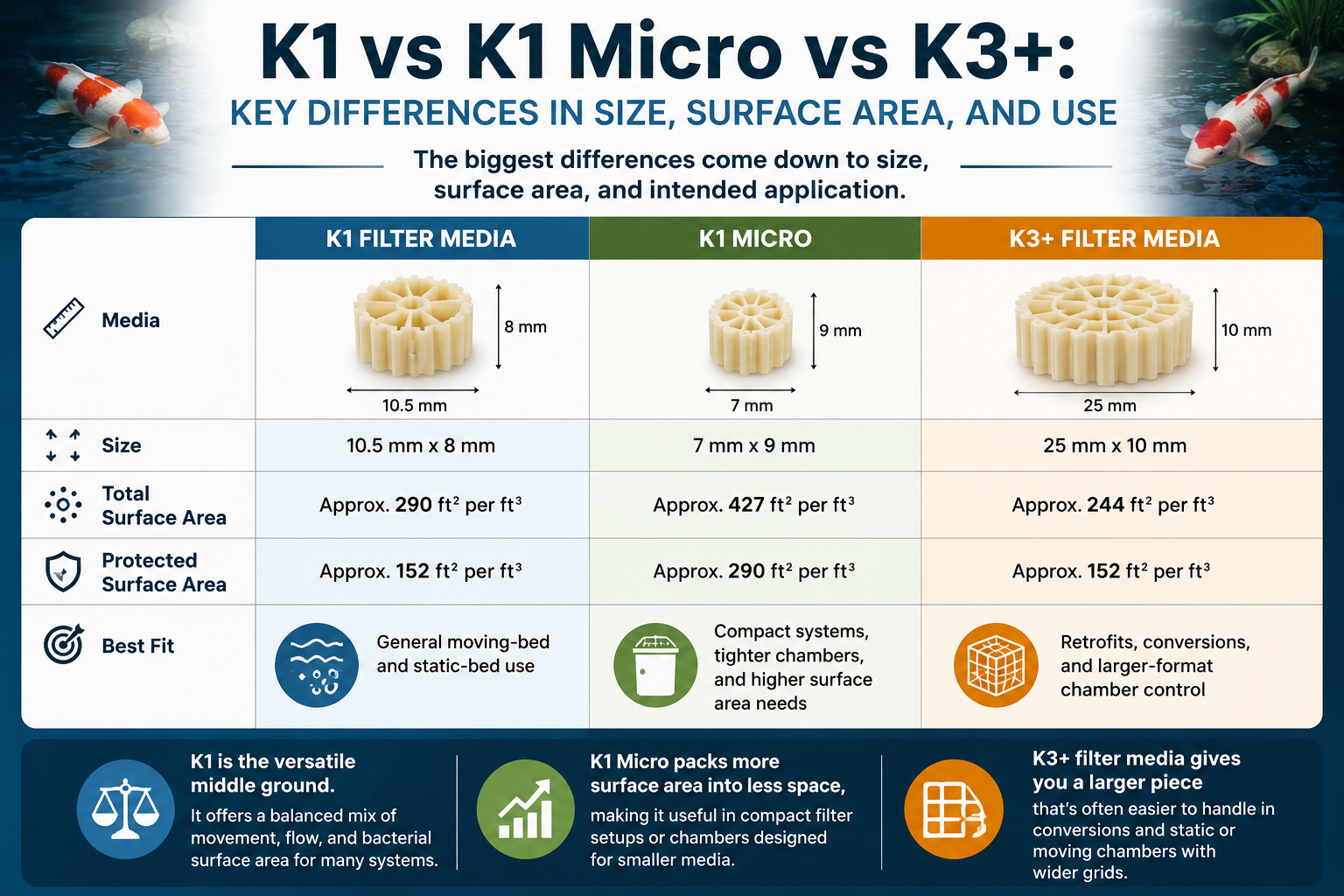
K1 filter media is one of the best-known options in pond filtration because it’s built for both moving-bed and static-bed use. It’s designed to increase filter efficiency, provide a large surface area for beneficial bacteria, and support both mechanical and biological filtration. The listed dimensions are 10.5 mm in diameter and 8 mm in length, with a total surface area of approximately 290 ft² per ft³ and a protected surface area of approximately 152 ft² per ft³.
In practical terms, K1 filter media is often seen as the all-around choice. It’s small enough to circulate well in moving chambers, large enough to manage flow properly, and proven in pond systems that need reliable biological support year after year.
For many pond owners, this is the starting point. It works well in dedicated bio chambers, established koi systems, and filters designed for moving-bed media. It’s also a strong option when you want dependable performance without getting too specialized.
K1 Micro uses the same basic design concept as K1, but in a smaller format. The listed dimensions are 7 mm in diameter and 9 mm in length, with a total surface area of approximately 426.72 ft² per ft³ and a protected surface area of approximately 289.56 ft² per ft³. Evolution Aqua also notes that its smaller size allows for a tighter media pack while maintaining good flow, resulting in strong mechanical and biological performance.
That smaller profile is what sets K1 Micro apart. You get more protected surface area in the same volume, which can make it attractive for compact systems, tighter chambers, or applications where maximizing bacterial habitat matters more than using a larger piece of media.
K1 Micro is often a smart fit when space is limited, and you still want serious biological filter media performance. It can also suit systems where flow is carefully controlled, and the chamber is designed to contain smaller media.
K3+ filter media is a larger-format option for both moving-bed and static-bed filters. Evolution Aqua says it is ideal for DIY projects and conversions, and its larger size makes it easier to control in retrofit setups while reducing the risk of media passing through grid slots. The published specifications list a 25 mm diameter and 10 mm length, with approximately 244 ft² per ft³ total surface area and approximately 152 ft² per ft³ protected surface area.
So where does that leave K3+ in real-world use? It’s often the answer when a chamber or conversion project needs larger media that’s easier to contain. If a filter wasn’t originally built around smaller media, K3+ can be a cleaner fit.
That doesn’t automatically make it “better” than K1 or K1 Micro. It simply fills a different role. Larger media can be easier to manage in some retrofits, while smaller media can offer more surface area in the same footprint.
The biggest differences come down to size, surface area, and intended application. In simple terms, K1 is the versatile middle ground. K1 Micro packs more surface area into less space, making it useful in compact filter setups or chambers designed for smaller media. K3+ filter media gives you a larger piece that’s often easier to handle in conversions and static or moving chambers with wider grids.
The best pond filter media depends on your existing system, not just the product name on the bag.
A standard moving-bed chamber with good aeration often pairs well with K1 filter media because it offers a balanced mix of movement, flow, and bacterial surface area. A compact filter with limited room may benefit more from K1 Micro because it provides more protected surface area per ft³ than K1 or K3+. A retrofit or DIY chamber with slot-size concerns may point you toward K3+ filter media, since its larger profile is easier to retain.
That’s why there isn’t one universal winner. The best biological filter media for one pond might be the wrong choice for another. Fish load, chamber size, flow rate, grid spacing, and how the filter was built all matter.
For koi ponds, matching media to the actual filtration design matters more than chasing the highest number on a spec sheet.
Moving-bed filtration works by keeping floating media in constant motion with aeration. As water flows through the chamber, the tumbling media exposes biofilm to oxygen and nutrients while helping reduce buildup on the media. For example, K1 filter media is used in moving-bed and static-bed systems, K1 Micro shares the same core structure in a smaller format, and K3+ is also intended for moving-bed and static-bed use.
For many pond owners, moving-bed media is the heart of the biological stage. It’s active, efficient, and well-suited to ponds where fish produce a steady waste load. That makes media choice especially important in koi ponds, where feeding rates can be high and stable water quality is non-negotiable.
The best media for a moving-bed filter is usually the one that the chamber can circulate properly. K1 is a strong general-purpose choice for many moving-bed setups. K1 Micro can make sense in compact systems designed to contain smaller media, while K3+ can be a better fit for retrofits or larger chambers where media retention is a concern.
Start with the chamber, not the catalog.
Look at the size of the filter bay, the screen or grid spacing, the available aeration, and the level of waste the pond produces. After that, think about whether your goal is a fresh install, a media upgrade, or a retrofit into an older setup.
K1 filter media is a great fit for pond owners who want a proven all-purpose option with balanced movement, flow, and bacterial surface area. K1 Micro makes sense when chamber space is tighter, and you want more protected surface area packed into the same volume. K3+ filter media is often the practical choice for conversions, larger-grid chambers, and setups where containing the media is a concern.
A koi pond filter media decision should always take stocking levels seriously. A lightly stocked ornamental pond and a heavily stocked koi pond won’t ask the same things from a bio chamber. The right choice is the media that fits the chamber, moves correctly, stays contained, and gives the biological filter enough room to keep up with the pond.
This is one of the most common questions, and the honest answer is that the required volume depends on pond size, fish load, feeding rate, and the efficiency of the rest of the system.
There isn’t one magic amount that fits every pond. A pond with a modest fish load and strong mechanical pre-filtration may need much less media than a koi pond with heavy feeding and high turnover. The filter chamber itself also limits how much media can move correctly. Overfilling a moving bed reduces circulation, limits oxygen exposure, and hurts performance.
A better way to think about sizing is this: add enough media to meet the pond's biological demand while still leaving room for the chamber to churn properly. The “more is better” approach can backfire if the media becomes crowded and loses movement. Good biological filtration depends on surface area, oxygen, flow, and contact time working together, not just how much media gets packed into the chamber.
Yes, in some systems, you can mix media types, but it should be done with care.
Mixing different media in the same chamber can change how the chamber moves, how air is distributed, and how evenly bacteria colonize the surfaces. Larger and smaller media may not circulate at the same rate, which can reduce the self-cleaning action you want from a moving bed. It can also make troubleshooting harder because one media type may be moving well while the other settles, clumps, or collects in a low-flow area.
In many cases, it’s cleaner to keep one chamber dedicated to one media type. If a system has multiple bays, different media can be used in different stages depending on the role of each chamber. That setup tends to be easier to manage, observe, and adjust if flow or aeration needs improvement.
One common mistake is choosing media based only on marketing language rather than chamber design. Even excellent biological filter media can underperform in the wrong filter if it can’t move properly, stay contained, or receive enough oxygen.
Another issue is ignoring retention screens. Smaller media need proper containment, especially in retrofits or DIY chambers that weren’t originally designed around it. Larger media may help solve that problem during conversion work, which is part of why K3+ filter media appeals to DIY pond owners.
Some pond owners also expect media to make up for weak mechanical filtration. It won’t. Heavy solids should be removed before they overwhelm the biological stage. In addition, overfilling a chamber or under-aerating a moving bed can reduce the benefits of even the best pond filter media.
Good media doesn’t need constant replacement, but it does need the right environment to perform.
Maintain strong aeration in moving-bed chambers so the media circulates and the biofilm receives steady oxygen exposure. Make sure pre-filtration is catching heavier solids before they reach the biological stage. Avoid unnecessary cleaning that strips away established biofilm. If the system does need cleaning, treat the biological stage gently and never sterilize mature media unless the goal is to fully restart the filter.
It also helps to watch the pond itself. Rising ammonia levels, nitrite issues, cloudy water, or fish stress can point to a biological stage that’s undersized, overloaded, under-aerated, or not moving as it should.
Steady maintenance almost always beats dramatic intervention. Keep the water moving, keep the media protected, and let the bacteria do the work they’re there to do.
The right media choice supports more than filtration on paper. It supports stable water, healthier fish, and a pond that’s easier to manage through the season.
K1 filter media remains a dependable choice for general-purpose biological support. K1 Micro is strong when you need more protected surface area in a compact footprint. K3+ filter media stands out in retrofits, conversions, and chamber designs that benefit from a larger format. The differences in size and surface area are exactly why each option serves a different role rather than competing as an exact substitute.
Once you match the media to the chamber, the rest of your pond filtration strategy makes more sense. Cleaner water, stronger biological support, and better long-term consistency usually follow.
For pond owners comparing K1, K1 Micro, and K3+, the main takeaway is simple: choose the media that fits the system you actually have, not just the one with the loudest headline.
Clear water starts with the right foundation inside your filter. If your system isn’t keeping up with fish load, feeding, or seasonal changes, it may be time to look at what’s inside the chamber, not just the equipment around it.
EA Media is engineered to support consistent biological filtration, stable water quality, and long-term performance under real-world pond conditions. Whether you’re building a new system, upgrading an existing filter, or fine-tuning a koi pond setup, choosing the right media can make a noticeable difference.
Here’s the simple version: better media gives beneficial bacteria more room to colonize, and stronger bacterial activity helps support healthier water.
Take a closer look at the full EA Media range and find the right fit for your filtration system today.
What Is The Best Pond Filter Media?
The best option depends on the filter design, chamber size, aeration, and the pond’s fish load. K1 is a reliable all-around choice for many moving-bed and static-bed systems. K1 Micro suits compact systems that need more protected surface area in the same volume. K3+ is often a strong fit for retrofits and conversions where larger media is easier to contain.
What Is The Difference Between K1 And K1 Micro?
K1 Micro is smaller than K1 and offers more total and protected surface area per ft³. K1 is the more general-purpose option, especially for standard moving-bed and static-bed use. K1 Micro is often selected when space efficiency matters most, but the chamber still needs to be designed to properly hold and circulate the smaller media.
What Is K3+ Filter Media Used For?
K3+ filter media is used in both moving-bed and static-bed filters, especially in DIY projects and retrofits. Its larger format can make it easier to retain inside chambers with wider grids or slots. That makes it a practical option when a filter wasn’t originally designed around smaller media. It isn’t automatically better than K1 or K1 Micro; it simply solves a different filtration problem.
How Much Pond Filter Media Do I Need?
That depends on pond volume, fish load, feeding rate, pre-filtration, and filter chamber size. A heavily stocked koi pond will usually place more demand on the biological stage than a lightly stocked ornamental pond. The best approach is to size the media to the pond's biological demand while preserving sufficient free space for proper movement and flow. Overfilling a moving bed can reduce circulation and hurt performance.
Can You Mix K1, K1 Micro, And K3+ In The Same Filter?
You can mix media types in some systems, but it’s usually cleaner to do it with a clear reason. Different media sizes may move at varying rates, which can affect circulation, air distribution, and the chamber's self-cleaning action. In many setups, it’s easier to keep one media type in each chamber or bay. That makes the system easier to observe, tune, and troubleshoot.
Is K1 Micro Better Than K1?
K1 Micro isn’t automatically better than K1. It offers more surface area per ft³, which can help in compact systems or chambers designed for smaller media. K1 is still a strong all-purpose choice because it moves well in many standard moving-bed setups and is easier to contain than smaller media. The better choice depends on the filter design, not just the surface area number.
Is K3+ Better For DIY Pond Filter Conversions?
K3+ can be a smart choice for DIY pond filter conversions because its larger format is often easier to retain inside older chambers, wider grids, or retrofit setups. Smaller media may pass through gaps if the chamber isn’t designed to hold it. K3+ offers pond owners a larger piece of media that still supports biological filtration while being easier to manage physically. For many conversion projects, that practical fit is the real advantage.
Does Pond Filter Media Need To Be Replaced?
Good biological filter media usually doesn’t need frequent replacement if it stays intact and the system is maintained properly. The goal is to protect the established bacteria living on the media, not strip everything clean every season. If media becomes damaged, brittle, clogged beyond recovery, or unsuitable for the chamber, replacement may make sense. Most of the time, better aeration, stronger pre-filtration, or gentler cleaning solves the problem before replacement is needed.
Can Pond Filter Media Fix Poor Water Quality On Its Own?
Pond filter media can support better water quality, but it can’t fix every problem by itself. Heavy solids, weak aeration, undersized pumps, overfeeding, high fish load, and poor pre-filtration can all overwhelm the biological stage. Media works best as part of a complete filtration system where mechanical and biological stages each do their job. If water quality keeps slipping, the full system needs to be reviewed, not just the media.
| Hours | |
|---|---|
| sunday | 10:00 AM - 4:00 PM |
| monday | Closed |
| tuesday | 10:00 AM - 5:00 PM |
| wednesday | 10:00 AM - 5:00 PM |
| thursday | 10:00 AM - 5:00 PM |
| friday | 10:00 AM - 5:00 PM |
| saturday | 10:00 AM - 5:00 PM |
| Hours | |
|---|---|
| sunday | 10:00 AM - 5:00 PM |
| monday | Closed |
| tuesday | 11:00 AM - 6:00 PM |
| wednesday | 11:00 AM - 6:00 PM |
| thursday | 11:00 AM - 6:00 PM |
| friday | 11:00 AM - 6:00 PM |
| saturday | 10:00 AM - 5:00 PM |
| Hours | |
|---|---|
| sunday | 10:00 AM - 4:00 PM |
| monday | Closed |
| tuesday | 10:00 AM - 5:00 PM |
| wednesday | 10:00 AM - 5:00 PM |
| thursday | 10:00 AM - 5:00 PM |
| friday | 10:00 AM - 5:00 PM |
| saturday | 10:00 AM - 5:00 PM |
| Hours | |
|---|---|
| sunday | 10:00 AM - 5:00 PM |
| monday | Closed |
| tuesday | 11:00 AM - 6:00 PM |
| wednesday | 11:00 AM - 6:00 PM |
| thursday | 11:00 AM - 6:00 PM |
| friday | 11:00 AM - 6:00 PM |
| saturday | 10:00 AM - 5:00 PM |
| Hours | |
|---|---|
| sunday | Closed |
| monday | 10:00 AM - 4:00 PM |
| tuesday | 10:00 AM - 4:00 PM |
| wednesday | 10:00 AM - 4:00 PM |
| thursday | 10:00 AM - 4:00 PM |
| friday | 10:00 AM - 4:00 PM |
| saturday | Closed |
| Hours | |
|---|---|
| sunday | 10:00 AM - 4:00 PM |
| monday | Closed |
| tuesday | 10:00 AM - 5:00 PM |
| wednesday | 10:00 AM - 5:00 PM |
| thursday | 10:00 AM - 5:00 PM |
| friday | 10:00 AM - 5:00 PM |
| saturday | 10:00 AM - 5:00 PM |
| Hours | |
|---|---|
| sunday | Closed |
| monday | Closed |
| tuesday | 10:00 AM - 5:00 PM |
| wednesday | 10:00 AM - 5:00 PM |
| thursday | 10:00 AM - 5:00 PM |
| friday | 10:00 AM - 5:00 PM |
| saturday | 10:00 AM - 5:00 PM |
| Hours | |
|---|---|
| Sunday | Closed |
| Monday | Closed |
| Tuesday | 10:00 AM - 5:00 PM |
| Wednesday | 10:00 AM - 5:00 PM |
| Thursday | 10:00 AM - 5:00 PM |
| Friday | 10:00 AM - 5:00 PM |
| Saturday | 10:00 AM - 5:00 PM |
| Hours | |
|---|---|
| Sunday | 10:00 AM - 4:00 PM |
| Monday | Closed |
| Tuesday | 10:00 AM - 5:00 PM |
| Wednesday | 10:00 AM - 5:00 PM |
| Thursday | 10:00 AM - 5:00 PM |
| Friday | 10:00 AM - 5:00 PM |
| Saturday | 10:00 AM - 5:00 PM |